How Baden-Württemberg unified regional mobility without rebuilding existing systems

Last updated: August 2026
Icons

Snapshot of success

Passengers already experience public transport as one connected network. Ticketing doesn't always reflect that experience. Different fare areas, operators and digital systems can make seamless travel harder than it needs to be.

Baden-Württemberg set out to change that.

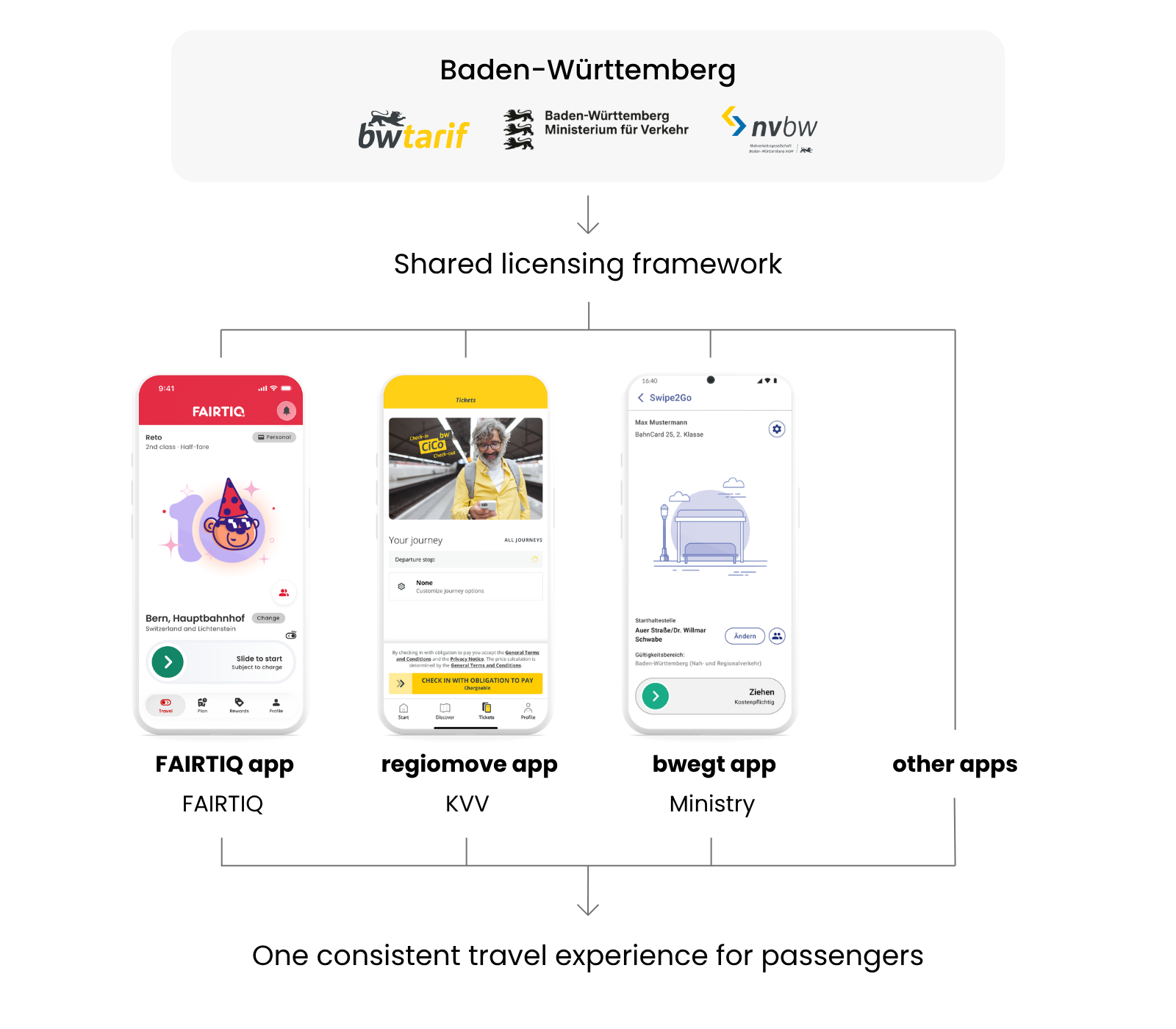
With CiCoBW (Check-in Check-out Baden-Württemberg), the Ministry of Transport Baden-Württemberg, the state's public transport authority (NVBW), BW-Tarif GmbH and participating transport associations created a shared framework for Mobile Pay-As-You-Go ticketing (MPAYG). Rather than asking every public transport organisation to develop its own app solution, the framework enables multiple app providers to offer one consistent, state-wide Mobile Pay-As-You-Go experience across Baden-Württemberg.

FAIRTIQ joined CiCoBW as a licensed app provider, extending its existing regional service across the state and beyond, making the service available to around 14 million people. Existing customers continued using the same app, account and payment method while gaining access to a much larger travel area.

Since the state-wide rollout in February 2025, passengers have completed more than two million journeys using FAIRTIQ technology, while peak active FAIRTIQ users have grown by 44.8%.

CiCoBW at a glance

icon_document_light
State-wide licensing framework for Mobile Pay-As-You-Go ticketing in Baden-Württemberg
icon_connection_light
One shared framework enabling multiple licensed app providers
icon_growth_light
2 million+ journeys using FAIRTIQ technology since February 2025
icon_support_light
44.8% increase in peak active FAIRTIQ users after the state-wide expansion

A regional challenge with national relevance

Across Europe, public transport networks have evolved over many years. Operators and transport authorities have developed ticketing solutions to meet regional needs, often using different technologies, commercial models and fare structures.

Passengers experience these networks differently.

They simply expect public transport to work, regardless of where one transport association ends and another begins.

For transport authorities, this raises an important question: How do you deliver one consistent passenger experience while allowing operators and transport authorities to remain independent?

Baden-Württemberg approached that question by creating a common framework instead of another standalone ticketing solution, creating a model that can be adopted at both regional and national level.

A framework designed to connect existing services

CiCoBW is a licensing framework that enables Mobile Pay-As-You-Go across Baden-Württemberg.

The framework establishes the common technical, commercial and operational conditions that licensed app providers use to offer MPAYG ticketing throughout the state.

For this to work it requires a lot of players. Each stakeholder contributes a specific part of the framework.

The State of Baden-Württemberg, together with organisations such as NVBW and BW-Tarif GmbH, provides:
  • central external pricing API (Fraunhofer IVI PKM) which covers all 19 fare networks plus two cross-regional fares of Baden-Württemberg
  • regularly updated statewide timetable data (GTFS)
  • microservices that facilitate the reporting of ticket sales in a centralised channel
  • the licensing framework with common commercial conditions, such as clear rules for income split and payouts as well as shared technical standards, including barcode requirements
Participating transport associations provide:
  • their fare products
  • testing before launch (optional)
Licensed app providers deliver:
  • passenger-facing apps with Check-In/Be-Out technology
  • customer registration and payment
  • ticket sales and revenue allocation in accordance with the licensing conditions
  • customer support
cicobw-case-study-stakeholders

This shared approach enables multiple providers to participate while giving passengers a consistent travel experience across the network. At the same time, it encourages licensed app providers to compete on user experience and service quality, giving passengers greater choice.

From four regional implementations to one connected experience

Before CiCoBW expanded across Baden-Württemberg, FAIRTIQ already had successful partnerships within four transport associations:

RVL logo website
Regio Verkehrsverbund Lörrach (RVL)
RVF logo website
Regio-Verkehrsverbund Freiburg (RVF)
KVV logo website
Karlsruher Verkehrsverbund (KVV)
Stuttgart logo website
Verkehrs- und Tarifverbund Stuttgart (VVS)

Our partner: S-Bahn Stuttgart

Each implementation successfully introduced Mobile Pay-As-You-Go within its own regional area.

Instead of replacing successful regional implementations, CiCoBW allowed them to become part of a much larger passenger experience.

FAIRTIQ joined CiCoBW as a licensed app provider and extended the coverage of the FAIRTIQ app across Baden-Württemberg. The same technology is also integrated into the regiomove app operated by KVV.

For existing FAIRTIQ customers, the transition was deliberately simple and frictionless.

They continued using:

  • the same app and FAIRTIQ account

  • the same payment method

  • the same familiar swipe experience

The main difference was that journeys no longer stopped at the previous regional boundary.

Proof that the framework works

Since the state-wide expansion in February 2025:

Metric
Result
Existing FAIRTIQ regions connected 4
Journeys since state-wide launch 2 million+
Peak active users before expansion (December 2024)* 21,016
Peak active users after expansion (December 2025)* 30,422
Growth in peak active users +44.8%

* Peak active users increased from 21,016 across the four FAIRTIQ regions to 30,422 across Baden-Württemberg following the state-wide expansion. Active users are defined as users who completed at least one journey within the previous 28 days.

These figures show how an established regional Mobile Pay-As-You-Go service can successfully expand within a shared framework while maintaining a familiar customer experience.

One framework, different benefits

The value of a shared framework reaches well beyond digital ticketing.

For passengers

Passengers experience public transport as one connected network.

They benefit from:

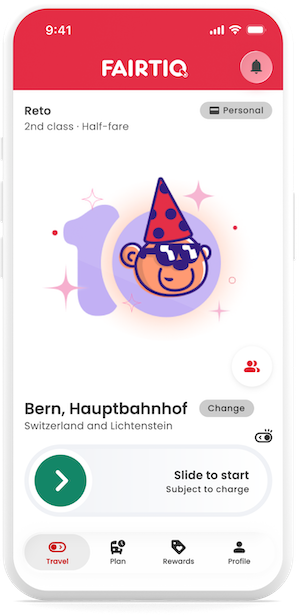
  • one swipe to start every journey

  • a valid ticket throughout the journey

  • automatic best fare calculation - taking into account all the different regional fare tariffs

  • a monthly fare cap linked to the current Deutschlandticket monthly fixed price, making CiCoBW attractive for frequent travellers

  • seamless travel across all 19 fare areas in Baden-Württemberg

  • no need to understand different regional fare structures before travelling

  • access through familiar transport apps like FAIRTIQ or regiomove
cicobw-case-study-screen

For transport authorities and operators

The framework creates a shared digital foundation that organisations can build on together.

It supports:

  • increased public transport adoption through a consistent, frictionless passenger experience

  • lower implementation effort through shared technical components and central services

  • continued independence for transport authorities and operators

  • automatic revenue allocation

  • the ability to make fare products available through multiple licensed app providers without operating additional sales channels

Three considerations for regions building similar frameworks

Baden-Württemberg demonstrates what is possible when public transport organisations collaborate around a shared framework. It also highlights opportunities that could make similar initiatives even more effective as they continue to evolve.

1. Build awareness alongside the technology

A shared framework only creates value if passengers understand how to use it. Clear communication is essential. Travellers need to know what CiCoBW is, which apps participate and how the framework makes travelling easier.

As Baden-Württemberg continues to expand digital ticketing, increasing public awareness will become just as important as expanding the technical platform. Greater awareness can also support the long-term goal of shifting demand towards more efficient digital sales channels.

2. Balance collaboration with agility

A shared framework succeeds when every stakeholder can contribute without slowing progress. As the number of participating organisations grows, finding the right balance between broad collaboration and efficient decision-making becomes increasingly important.

The same applies to the organisations operating central services. Continuous investment in their capabilities and capacity helps ensure that shared infrastructure remains reliable, scalable and ready to support future growth. This needs to be factored in from the beginning, when projects are conceived.

3. Invest in shared infrastructure

A common framework becomes even more attractive when more technical services are shared centrally.

Baden-Württemberg already provides several central components. Future frameworks could go one step further by introducing:

  • central clearing system, reducing implementation effort for participating providers and simplifying ticket sales

  • centrally managed barcode certificates and inspection infrastructure, making ticket validation more efficient and consistent across all participating providers

  • common minimum standards for Check-In/Check-Out technology covering areas such as fraud monitoring, fare calculation and operational reliability

Expanding common infrastructure and frameworks in this way would reduce complexity for every participant while creating a stronger foundation for future state-wide or nationwide Mobile Pay-As-You-Go ticketing.

A model other regions can build on

CiCoBW demonstrates that regional integration is about more than connecting technology. It requires a framework that brings together governance, commercial agreements, technical standards and a shared vision for passenger experience.

Baden-Württemberg shows that several principles create lasting value.

icon_node_light
Eliminate ticketing boundaries

Passengers experience one connected network, even when several transport authorities and operators are involved.

icon_business_light
Preserve operator independence

Transport authorities continue managing their own services and fares while participating in shared commercial and technical conditions.

icon_arrow_down_light
Reduce duplicate investment

Shared pricing services, reporting and technical standards reduce the need for every organisation to develop and maintain equivalent capabilities independently.

icon_idea_light
Encourage innovation

An open licensing framework allows multiple providers to participate, creating room for innovation and giving passengers greater choice.

What it takes to scale Mobile Pay-As-You-Go

The following building blocks can help regional frameworks grow into state-wide or nationwide ecosystems. They represent an ideal long-term vision rather than a set of requirements. Projects can begin successfully without every element being in place from day one.

icon_ticket_dark
1. Reciprocal ticket sales

A common commercial framework that allows every public transport operator in the affected region to sell every participating fare product, regardless of their location.

icon_light_bulp_dark
2. A sustainable commercial model

A fair remuneration model that compensates providers for distribution, payment processing and operational costs, while creating incentives for innovation and high-quality customer experiences.

icon_document_dark
3. Nationwide barcode standard

A standardised barcode and inspection infrastructure that enables ticket validation across the whole state or nation, through centrally provided barcode certificates and verification services.

icon_computer_dark
4. Central fare server

A central fare server providing free access to fare data from all transport operators, transport associations, federal states and regions.

Alternatively, a significantly simplified fare landscape, such as eFares, could reduce the complexity of fare calculation.

icon_central_dark
5. Central clearing and settlement

A central clearing and settlement mechanism that supports reciprocal ticket sales and automates revenue allocation between participating organisations.

icon_swipe_dark
6. Minimum standards for Check-In/Check-Out technology

Common quality standards for Check-In/Check-Out solutions to ensure consistent performance in areas such as:

  • fare calculation

  • journey mapping accuracy

  • data protection

  • settlement processes

  • fraud detection and prevention

  • operational reliability

Looking ahead

Passengers already think in journeys rather than organisational boundaries.

Baden-Württemberg has shown how a shared framework can bring ticketing closer to that expectation while allowing transport authorities, operators and technology providers to contribute their respective strengths.

For organisations exploring regional or nationwide Mobile Pay-As-You-Go, the case demonstrates that scaling digital ticketing starts with creating the right framework for collaboration.

If your organisation is considering a similar approach, we'd be happy to share how FAIRTIQ's experience can support your next step.

Ready to modernise public transport ticketing?

Discover how a mobile-first ticketing platform powered by Mobile Pay-As-You-Go can help you reduce costs, support every passenger and simplify fare collection with minimal hardware.